
Hymns of the Creator: Worshiping the Creator in Response to His Creation
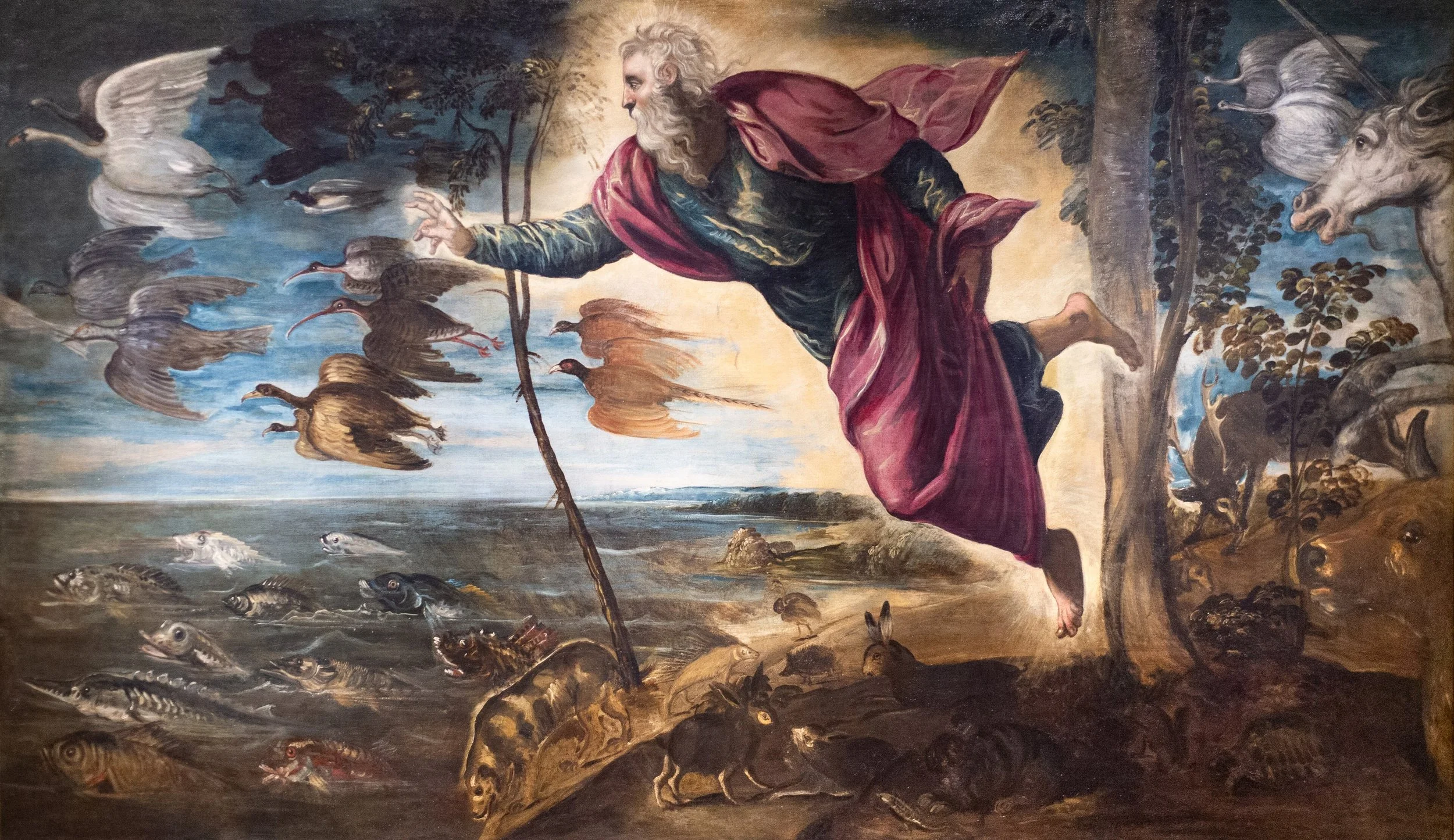
Above: Creation of the Animals by Jacopo Tintoretto
“Worship the Creator, not the creature,” is a common phrase uttered and prayed by many Christians, including myself. As human beings, made in the image of God, we are to reflect God himself. As believers, our desire, rightfully so, is to fix our eyes and affections on the Lord. This is in line with the Westminster Catechism’s chief end of man, “...to glorify God…” But what about the rest of the sentence, “...and enjoy him forever”? For fear of drawing attention away from the object of our faith, we occasionally become blind to anything less than objective–missing opportunities to truly enjoy and behold God’s beauty.
One way I have been reflecting on this recently is songs I call “hymns of the Creator”. I do not remember the first time I had heard the great hymn, “How Great Thou Art”, but I do know it was years until I heard the second verse of this hymn:
When through the woods and forest glades I wander,
And hear the birds sing sweetly in the trees;
When I look down from lofty mountain grandeur
And hear the brook and feel the gentle breeze
This verse is often skipped over. Try googling the lyrics to this hymn. Chances are, the lyrics from Carrie Underwood’s or Alan Jackson’s recordings come up, both of which leave this wonderful verse out. (Both of these recordings are certainly worth a listen, though. Alternatively, Steven Curtis Chapman does include this verse.) My suspicion is that Carrie Underwood, Alan Jackson, and many churches skip this verse because it is not as explicitly about God or the gospel when compared to the other verses. While this is true, I believe we lose something incredibly valuable when we dismiss a verse like this. When we witness creation, we witness the handiwork of the Creator, and that should spur us on to worship, “Then sings my soul, my Savior God, to thee: How great thou art!”
To be fair, the first verse also considers the wonders of God’s creation, but, there is something to be said of the specificity and exclusivity with which the second verse sings. From a simple walk in the woods or feeling a gentle breeze to taking in a vast mountainscape, witnessing and experiencing the beauty of creation is an act of worship.
“How Great Thou Art” is far from the only hymn that utilizes the beauty of creation as a poetic tool to point towards worship. The patron saint of animals and ecology himself, St. Francis of Assisi, penned the words to one of the most popular hymns of all time, “All Creatures of Our God and King”. This hymn of the Creator does a wonderful job of reflecting on creation while also pointing the singer towards the triune God. It begins with a call to worship, “All creatures of our God and King / Lift up your voice and with us sing…” before considering the sun, moon, stars, and the rushing wind–all of which receive the same response, “O praise Him! Alleluia!” The culmination of this hymn is sung in its final verse:
Let all things their creator bless,
And worship him in humbleness,
O praise Him! Alleluia!
Praise, praise the Father, praise the Son,
And praise the Spirit, Three in One.
O praise Him! O praise Him!
Alleluia! Alleluia! Alleluia!
Both “How Great Thou Art” and “All Creatures of our God and King” take in the beauty of creation and point towards praise and adoration of God. Other such hymns of the Creator emphasize a joy and comfort found in God’s rule over creation. As with “All Creatures of Our God in King”, the final verse of “All Things Bright and Beautiful” gives us its ultimate proclamation, a gratitude for God and the peace He brings:
He gave us eyes to see them,
And lips that we might tell:
How great is God Almighty,
Who has made all things well.
Similarly, “This Is My Father’s World”, sung at King’s Hill for the first time this past Sunday, ends with a godly rest and joy in the Lord’s hand over all creation:
This is my Father’s world
O let me ne’er forget:
That the though the wrong seems oft so strong,
God is the Ruler yet.
This is my Father’s world
Why should my heart be sad?
The Lord is King: let the heavens ring!
God reigns; let the earth be glad!
The hymns of the Creator are not unique in their approach in considering creation as an act of worship. The hymnwriters drew inspiration from Scripture for this poetic contemplation. The psalms are replete with examples of looking to creation as a way to ultimately look to the Creator. One of the first verses that likely comes to mind is Psalm 19:1, “The heavens declare the glory of God, and the sky above proclaims his handiwork.” Or, a little more abstractly, Psalm 42:1, “As a deer pants for flowing streams, so pants my soul for you, O God.”
In Matthew 6, Jesus famously points us to His creation, to the lilies of the field and to the birds of the air, as a means to communicate his love, care, and provision for us. Flipping a few books over, we see John open his gospel with the important notion that Jesus is the eternal God, the Creator of all things. When we look to our Savior, we look to our Creator. We should be greatly humbled by this truth just as Job was in Job 38. (Ghost Ship has an incredible song titled, “Where Were You?” based on this encounter between Job and God.)
My hope in this brief examination of these hymns of the Creator is that you take in a greater appreciation and awareness of our Creator as you go about your day. We need to be looking to Scripture and communing with His people, but these acts can often only happen in isolated moments. How wonderful it is to know that in the midst of the mundane, everyday tasks, as you run an errand, eat your lunch, or walk to the train station, you are witnessing God’s creation, and He is there with you!
Not only does beholding the beauty of creation benefit your own walk with the Lord, it can also be of great value to your witness of the gospel. The Apostle Paul in Romans 1:20 reminds us that God is clearly perceived in creation; he also speaks of this same common grace in Acts 14:17, “Yet [God] did not leave himself without witness, for he did good by giving you rains from heaven and fruitful seasons, satisfying your hearts with food and gladness." We desire for people to know God more fully; why not point to His work that they are already familiar with?
For those reading this in Boston (or any other city, for that matter), you may feel the same discouragement felt by G. K. Chesterton, “For us who live in cities, nature is not natural. Nature is supernatural. Just as monks watched and strove to get a glimpse of heaven, so we watch and strive to get a glimpse of earth. It is as if men had cake and wine every day but were sometimes allowed common bread.” If you are feeling this discouragement, please be reminded that there is beauty to behold in the city. Take in the art of the image-bearers of God: architecture, paintings, music, etc. Even the ingenuity of urban development (as imperfect as it may be) comes from the creativity of minds given to us by our Creator. Perhaps more simply, to be in a city means you are surrounded by more image-bearers of God. If you do live in Boston, know that we are blessed in comparison to many other U.S. cities with our access to greenspaces and parks. In the city of Boston, you are never more than a ten-minute walk from a park. Do not take this for granted!
My wife, Katie, and I have a small notebook in which we have been writing short notes for our 3-month old daughter, Margot, to read later in life. Just days prior to her birth, I wrote to her, “I am excited for you to see and experience the wonderful world God has blessed us with.” I say the same to you. Go experience God’s wonderful world. Witness His handiwork. Glorify God, and enjoy Him forever.
