
Disaster Relief Ministry: A Cold Cup of Water in Jesus’ Name
“And whoever gives one of these little ones even a cup of cold water because he is a disciple, truly, I say to you, he will by no means lose his reward.” - Matthew 10:42
Have you ever felt a desire to answer Jesus’ call to serve those who are hurting? Have you ever thought about what kind of impacts could be made on a community if multiple churches came together in Jesus’ name?
Earlier this month, Hurricane Isaias made landfall on the gulf coast of Florida as a Category 2 hurricane, moving north through Alabama, Tennessee, and the Appalachian Mountains before bringing us a rainy weekend here in the northeast. While the most we saw here was a couple days of consistent rain showers, portions of the gulf coast are still recovering from a storm that has had significant effects across many communities. Flooding, powerful winds, and dangerous storm surge has left many picking up the pieces of damaged homes and businesses, or even displaced entirely.
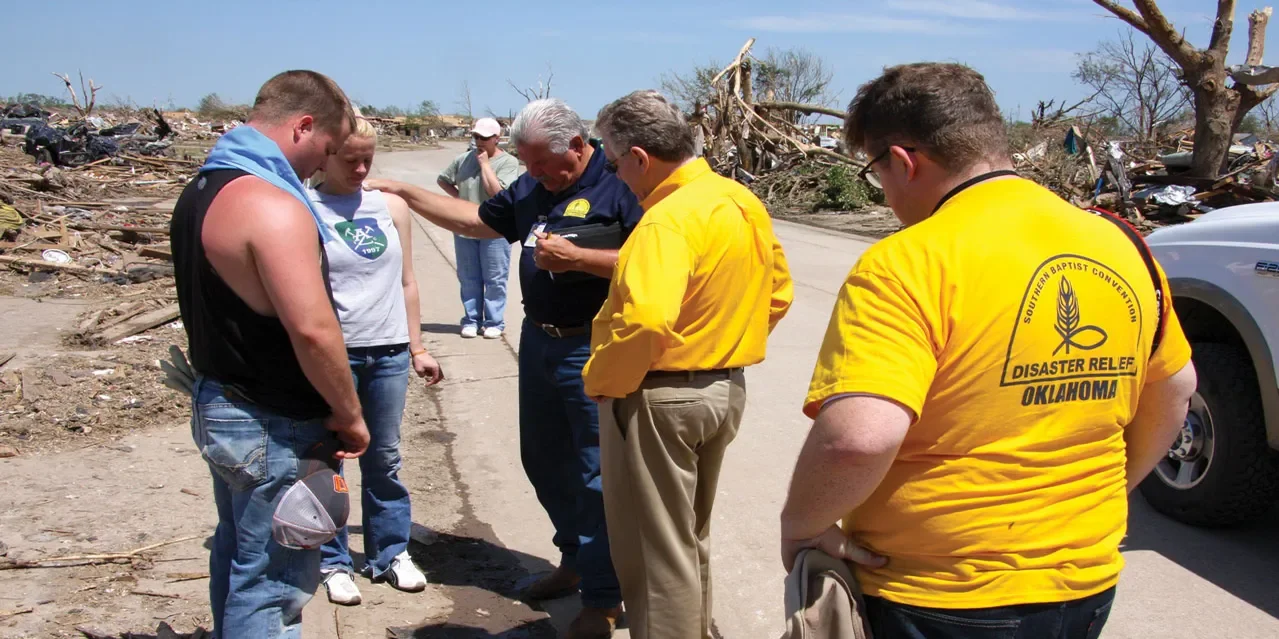
Behind the scenes, churches were mobilizing volunteers as soon as the weather forecast showed that Isaias was headed for Florida. This is one of the most consistently striking examples of the Church in action: Disaster Relief Ministry. State by state, churches band together to train volunteers to be ready to go at a moment's notice. As soon as the conditions are safe, they come in ready to help an affected community pick up the pieces, rebuild what’s been torn down, and of course, share a cold cup of water in Jesus’ name.
In my time working as a ministry assistant for a county-level baptist association in Alabama, I had a front row seat to the full breadth of the operation being run by state-level Southern Baptist Disaster Relief teams, dubbed “The Yellow Shirt Army” for the color of the volunteer shirts they wear in the field. When Hurricane Helene came through the Florida Panhandle and southern Georgia in 2024, I watched as Alabama Baptist Disaster Relief, Florida Baptist Disaster Relief, and Georgia Baptist Disaster Relief coordinated well ahead of time to make sure they would have volunteers in every affected community as soon as they could get them there. My own association played a part in this, helping to notify and mobilize all of the available volunteers that attended any of the 48 churches in our association. Chaplains, chainsaw operators, servers for mass feeding, and more were in Georgia as soon as the rain stopped.
It doesn’t stop with Southern Baptist Disaster Relief though: those volunteers were met by more hands from Samaritan’s Purse, Send Relief, The Salvation Army, and more. “The Big C Church” came together across state and denominational lines to serve others by being the hands and feet of Christ.
That is ultimately what this is about: Being the hands and feet of Christ. Those volunteers that dropped everything to go serve in southern Georgia weren’t being paid for their time there. In fact, getting and maintaining a volunteer certification with some of these ministries actually costs money, not to mention the time off of work most took in order to be available. But you don’t go into a community devastated by a natural disaster and think: “What is in this for me?” If you’ve ever served at The Big Move here in Boston, you’ve likely experienced the incredulity people will meet you with when they find out you’re volunteering your time and labor (even more so when our partners from across the country say they came just to help with this). That is usually when the window for a gospel conversation opens: What could compel someone to drop everything and volunteer their time and labor to serve in love a complete stranger? The love of Christ.
Indeed, Disaster Relief becomes one of the most impactful ways to illustrate Christ’s love to entire communities at a time. As Christians, our hope is in Christ and that hope compels us to care for our neighbors in practical and tangible ways: rebuilding damaged homes, removing fallen trees from people’s property, feeding those without a kitchen, clearing roads, or ultimately just being with those who are grieving. And when people ask what could compel us to take such action as volunteers, there opens an opportunity to tell them about where our hope is found: In Jesus.
What I’ve always loved about “The Big C Church”, that is, God’s people when viewed collectively across all churches and denominations, is that you see just how global, pervasive, and life changing the gospel is at the societal level. When we zoom out on disaster relief ministry, we see that this goes far beyond any one denominational or ministerial group.
Take, for instance, the Los Angeles wildfires of January 2025: a devastating disaster that prompted evacuation orders and warnings affecting as many as 200,000 residents and ultimately destroyed more than 18,000 structures. Even as the fires were still burning, Send Relief was sending funds and supplies to California Baptist Disaster Relief teams, so churches could be meeting needs on the ground even in the midst of the ongoing blazes. This initial response allowed CSBDR teams to mobilize and deploy a mobile kitchen that fed both victims of the fires and the first responders at the front lines.
“The Bible says the early church community was known for the way they cared for each other and the people around them. And that’s honestly what we need to be as well.” said Pastor Jared Osselear of Story CIty Church in Pasadena.
But who was there when the fires subsided, the news cameras left town, and families were allowed back into their former neighborhoods to pick up the pieces? This is where Samaritan’s Purse stepped in to make sure that the hope of Christ was still felt even in the aftermath and cleanup efforts. They sent teams of volunteers to help victims sift through burnt out homes in an effort to recover items of sentimental or financial value. Samaritan’s Purse supplied the community and victims with specialized tools and equipment for these tasks.
But even as practical needs are met, chaplains are also present to ensure emotional and spiritual needs are met as well.
“People need to tell their story,” said Franklin Graham, president of Samaritan’s Purse. “This is the most traumatic event of their life—how they escaped from the flames and got out of there. Chaplains will just listen and pray with them and encourage them, letting them know that God hasn’t turned His back on them, that God loves and care for them. It’s a very important ministry that helps them emotionally and spiritually.”
“A lot of people are asking, ‘Why?’ Graham said, “That’s a hard question to answer but we want to reassure them of God’s love.”
While Send Relief, SBDR, and Samaritan’s Purse made sure communities were supported in the immediate fires and the aftermath, Christian organizations like Convoy of Hope arrived ready to help for the long haul. Even as the media and news cameras moved on months after the fires, the reality of the victims of the fires was that this would not be a quick fix or recovery, and many needs remained as hospitals, clinics, schools, food pantries, and grocery stores remained closed if not outright destroyed.
Convoy of Hope hosted neighborhood events throughout 2025 and 2026 focused on distributing supplies to these communities. One partner church of Convoy, Believe LA Church, was even able to send relief supplies into affected communities with first responders in a time where only first responders were allowed in certain areas.
Even up to today, organizations like World Relief partner with area churches to offer grief counseling to those still hurting.
“Everyone wants to be around people in their best times, but who can be there with you in your worst?” said Pastor Aaron Lindsey of Believe LA. “We were able to show people that they can depend on the Church to do its part.”
Disaster Relief New England, a ministry of BCNE (Baptist Churches New England) and partner to fellow SBDR ministries, holds training a few times throughout the year for those interested in serving. The great thing is that Disaster Relief New England volunteers don’t just wait for disaster to strike in New England, but are ready to answer the call wherever it may come from.
Recently, a 16 person volunteer team served in West Virginia in the aftermath of flooding, serving both victims and first responders. Ed Lucas, who leads the Disaster Relief New England team, said they were returning a favor.
“Well, for disaster relief, you know, when we have issues in New England, West Virginia comes up, so we always try to go back and help those states that come up and help us. . . . They’ve been to Barre [Vermont] two years in a row, so it was our turn to come down and help in West Virginia,” Lucas told a reporter.
Disaster Relief New England volunteers also responded to flooding in New Hampshire in two consecutive summers in 2023 and 2024. In 2024, they helped home owners to power wash their homes, served over 5,000 meals, and gifted bibles to those affected, all while disaster relief chaplains prayed for those in need of spiritual care.
If you've felt the Lord moving you to serve people in their time of greatest need, or if you're simply interested in learning more about disaster relief ministry, consider exploring the organizations below. Whether through training, volunteering, prayer, or financial support, there are many ways to help the Church bring practical assistance and the hope of Christ to communities in crisis.
Disaster Relief New England (BCNE): https://www.bcne.net/disasterrelief
Send Relief: https://www.sendrelief.org/
SBDR: https://www.sbdr.info/
Samaritan’s Purse: https://www.samaritanspurse.org
World Vision: https://www.worldvision.org/
Convoy of Hope: https://convoyofhope.org/
