The Collapse of Modern Sexual Ethics
We all have beliefs around sex. But are these beliefs consistent without our deepest longings? Below, I'm going to present a number of statements that I believe the average irreligious person in our culture would largely sign off on. We can call it the creed of modern sexual ethics.
As you'll see, at the center of modern sexual ethics is the autonomous self—the belief that freedom means defining ourselves according to internal desire rather than according to a received design.
First, "Love is love."
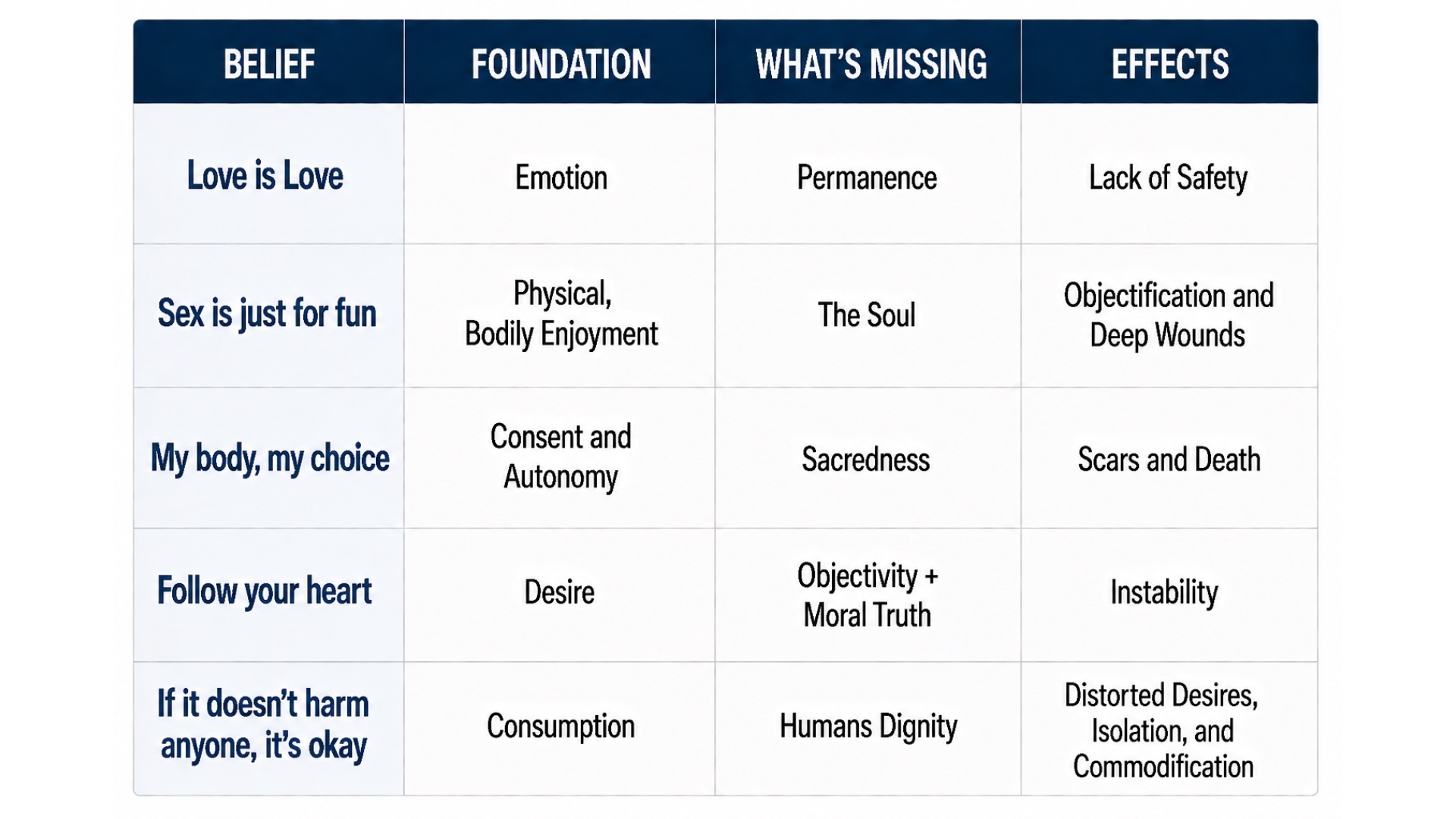
Here, the foundation is emotion. There are no boundaries around it. If it feels good, then it must be right. However, it lacks permanence. There is no belief in a covenant that holds a relationship together when it inevitably goes through hard seasons. It is a romance that bears unrealistic weight and cannot stand when confronted with moral obligations or responsibilities. When covenant disappears, feelings must carry the full weight of permanence, and feelings were never designed to do that. In other words, once the emotions no longer feel good, the relationship dissolves. Because the foundation is emotion, which changes, relationships become easily disposable. The end result is that you enter a relationship with no promise of safety.
Second, "Sex is just for fun."
We have sex to play around. It's simply a physical act. Choosing a partner is not much different than choosing a restaurant. It's about the experience. The issue with this view is that it elevates the body and diminishes the soul. What this leads to is objectification. The person you are enjoying this physical act with is not someone to cherish and love, but someone to be used for your enjoyment. You have substituted their personhood for instrumentation.
And this is where deep wounds are created. If you have been sexually hurt, abused, violated, or used, you can testify to the fact that sex is not just physical. If someone breaks a bone, they typically heal in four to six months. But if someone has been sexually abused, violated, or betrayed, it can take years to recover. Why is this? Because the wound is more than physical. It exists at the soul level.
Third, "My body, my choice."
The foundation here is consent and autonomy. Instead of a body that has been given to you and received from a Designer, you are free to modify and define yourself however you please.
In Homo Deus, Yuval Noah Harari argues that because we are technologically advanced, humanity is beginning to construct itself in ways once attributed to God. He calls this transhumanism. The modern self increasingly treats the body not as something received, but as raw material to redesign according to desire.
If the body is treated like a computer that can be engineered, then it is no longer viewed as a gift but as a customizable project. The component this lacks is sacredness. If the only consent I need to do something to my body is my own, because I am no longer a steward of a body given to me by a higher authority but rather its owner, then the only meaning my body has is the meaning I choose to place upon it.
Sadly, the effects of this can be seen not only in the physical scars people bear as they attempt to alter their bodies, but also in death. "My body, my choice" is often used in discussions surrounding abortion. Yet a choice had already been made before the choice of abortion—the choice to disconnect sex from sacredness. There is only one act that gives rise to another life, and when autonomy becomes the highest good, another life can begin to feel like a threat rather than a gift.
Fourth, "Follow your heart."
The core that undergirds this statement is desire. We run off intuition and gut feeling. But it is missing objectivity and moral truth. Beyond our own internal dialogue, there is no higher court of appeal to issue a verdict other than what we want deep inside. What happens when two people who are following their hearts are at odds with one another? Who or what can mediate? What is the higher authority? The problem with "follow your heart" is that the desires of our hearts are constantly changing and fluctuating. It makes a terrible compass. Unless we have something outside ourselves by which our hearts can be anchored, we will be tossed about like a ship in a storm. The effect is instability.
Fifth and finally, "If it doesn't hurt anyone, it's okay."
The foundation for this is consumption. It's an appetite to fill. This statement most often applies to solo sexual activity such as pornography or masturbation. It overlaps slightly with "sex is just for fun," but to an even greater degree human dignity is removed. The consequence is distorted desires and isolation. Studies have shown that when sexual gratification is pursued through a proxy rather than through genuine intimacy, it often lends itself to avoidance of real-world relationships and lower overall relationship satisfaction.
Taken together, these ideas form a vision of sexuality shaped by autonomous desire. The problem is not that each statement is entirely wrong. The problem is that none of them are capable of carrying the full weight of what sex was created to be.
The chart below is an attempt to visualize that framework. It illustrates why modern sexual ethics ultimately struggles to hold together everything sex was created to be. We should not be surprised when harmful effects follow. When we move against the design of something, we eventually experience the consequences.
Only Christianity offers a holistic vision of sexuality where security, sacredness, and stability are all possible. In the next article, we'll explore that vision. What framework is capable of holding all these realities together? Scripture offers a compelling answer, and it does so by holding together four truths that our culture continually pulls apart.