
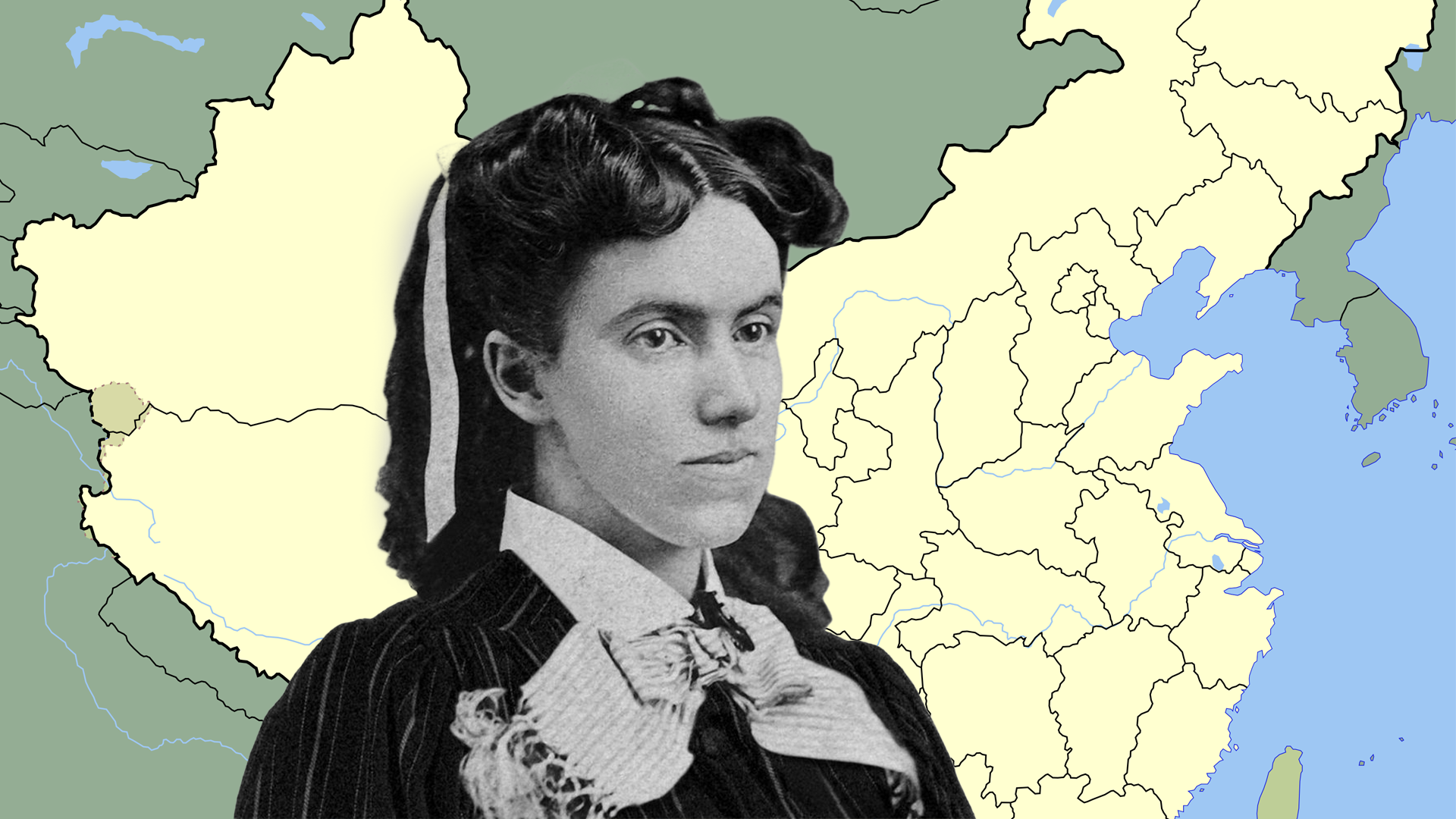
Charlotte Digges Moon, known as Lottie Moon, grew up on a tobacco plantation of over three thousand acres in Albemarle County, Virginia. She came from a family connected to prominent figures of early American history, including Thomas Barclay, an associate of Thomas Jefferson. In 1840, Edward and Anna Moon welcomed Lottie, their sixth-born child but the fourth surviving. She grew up wealthy monetarily, but more importantly, her parents possessed a rich faith they sought to instill in their children. Sundays were strictly reserved for reading the Bible and other Christian books. Margin was carefully guarded for discussion of “uplifting and fitting” matters.
By age ten, Lottie did not express much interest in religious things. An impactful moment in her childhood, however, came when her aunt and uncle, along with three cousins, decided to move overseas with the denomination of the Disciples of Christ. At the time, she thought living as a missionary was a way to waste one’s life. Still, a decision to do such a thing left an impression on her young mind.
At age fourteen, she enrolled in a boarding school, and after graduating, she attended Albemarle Female Institute. Though she excelled in languages, she was not ready to give up on fun. She was both a skeptic of the faith and a prankster. One April Fool’s Day, she climbed up the belfry tower of her school and draped the clapper of the bell with blankets. When the caretaker stood in position to ring the bell and wake the students at 6:00 a.m., nothing happened. It would take an entire hour to solve the problem. She was close to graduation at this point, so they did not expel her, yet her report card in conduct was marked “D” for deficient.
As her life unfolded, she would keep this defiant edge—one that God would eventually use to wake up an entire denomination to missions. But first, God would wake up Lottie to the truth of Jesus.
When God Used a Barking Dog
One evening, she had been prevented from sleeping because of a barking dog. Late-night thoughts, alone in her bed, led her to conclude that she should honestly investigate Christianity—no longer criticizing those who believed, but also no longer accepting her childhood instruction in the faith without examination. This inquiry led her to accept the Bible as true, her need for Jesus as essential, and a life of surrender as the inevitable conclusion.
Lottie completed her studies one month before the first shots of the Civil War were fired in northern Virginia. Her father, Edward, had died in a riverboat accident when she was only twelve years old. The war brought severe consequences for her mother, who now oversaw the plantation alone. As she was forced to sell parcels of land out of necessity, she remained determined that all of her daughters receive a strong education. The rights and opportunities available to women were few at this time, yet Lottie inherited a heritage of relatives who often prevailed over cultural expectations.
Lottie taught at a school in Danville, Kentucky, for four years. She briefly returned home when her mother became ill and eventually passed away in 1870 at the age of sixty-one. After teaching in Danville, she accepted a teaching position in Cartersville, Georgia, offered by one of her cousins. Only a year had passed when she received news that would forever alter the trajectory of her life.
Her sister, Edmonia, had been appointed as a single missionary to China. Harriet Baker had been the first single woman formally appointed by Southern Baptists to overseas mission work, but her appointment was short-lived and troubled, contributing to Southern Baptist hesitancy toward appointing single women for decades afterward. Because of this failed appointment, the Civil War, and a lack of funding, the Southern Baptist mission board had not selected a female missionary in roughly fifteen years.
Yet now the door had reopened.
The same young woman who once believed missionary service was a waste of life found herself drawn toward the very calling she had dismissed. She applied to the mission board and was accepted. At thirty-two years old, Lottie Moon was preparing to leave behind her home, her career, and everything familiar to carry the gospel to China.
Crossing the Ocean
The women of First Baptist Church of Cartersville, where she attended while teaching, banded together and formed a missionary society to help support Lottie in her newfound calling. This group of women committed “to deposit at least two cents a week upon the first day of every week.”
Her message to this special, committed group was, “Right noble have you held the rope.” The ladies responded, “Right noble have you gone into the well.” Missions was a shared effort between sender and goer. For decades, this band of women held the rope stretched across 7,000 miles as they supported Lottie going into the well of China's lostness. Having signed the standard Baptist missionary contract stating that she was committed to remaining in China until “a total breakdown of health, or death,” she set sail.
In China, she would take her experience in education and the giftings God had given her in languages and employ them on the mission field. Early in her missionary journey, she taught in a school for girls. She would later return to school work in her later years, but most of her forty years in China were spent doing what was known as “village work.” Nothing from her past would go to waste in this harvest field.
At the time, missionary work in China was often described in five major regions: North, South, Central, Interior, and Pakho. Lottie spent her entire missionary career in the northern province, first in Tengchow and later in Pingtu. Yet in her holy defiant way, she continually pressed the bounds of what was typical for women missionaries—both back home in America and on the mission field.
In America, Southern Baptists largely operated according to what was known as the “Woman's Work for Women” policy. On the mission field, women were expected to support their husbands through domestic responsibilities and child-rearing. Single women were expected to focus on educational work, creating opportunities to reach children and their families.
At this time, women in the Southern Baptist Convention were not permitted to vote in denominational business meetings. While such participation was never officially sanctioned by the Board, Lottie and other women missionaries often took part in field-level decision making, revealing the growing tension between mission-field realities and denominational policy.
Lottie took to writing. Across America, small groups of women had formed missionary societies much like the one in Cartersville. Her status as one of the first single women sent abroad, her strong personality, her giftedness as a writer, and the financial support these societies provided all pressed the issue. In time, the Convention relented, stepping back from attempts to exert authority over field decisions and the women carrying out the work. The groundwork was being laid for the eventual granting of women's voting rights within the denomination years later.
In China, she also stretched the bounds of a woman's work. She expanded beyond the normal teaching role into pioneering evangelistic work among the villages. While she sought to follow the protocol of evangelizing women and children, she was often the sole laborer in Pingtu.
Think about this for a moment.
In a city like Boston, if we conservatively estimate that 3 percent of the city's 650,000 residents are Christians, there would be approximately 19,500 believers. More or less, if every Christian took responsibility to evangelize and disciple thirty-five people, the entire city could be reached. Yet anyone who has participated in evangelism and discipleship knows how taxing that work can be even with five people.
In northern China, however, there might be a single Christian witness for hundreds of thousands of people—even into the millions. The harvest was vast and the laborers were painfully few. Inevitably, this meant that Lottie's work extended beyond women and children. The spiritual needs around her were simply too great.
Daily life in China was not easy. Travel often took place by shentze, a rope car covered by a basket and mounted on poles pulled by mules. Lottie would travel to multiple villages on any given trip. One such journey lasted four days, covering thirty miles each day.
The nights were no easier than the days. She stayed in inns where rats ran across her feet and ticks and lice crawled over her body. By the first evening of one journey, she had scratched her skin raw. She slept on brick beds in rooms with dirt floors and walls blackened by the smoke of generations.
Then, after long days of travel, she would speak for hours. Mandarin Chinese placed considerable strain upon her throat, yet how could she leave sincere spiritual questions unanswered? The physical hardships were many, but the opportunity to proclaim Christ compelled her onward.
Winters were almost unbearable, especially when icy winds and hard rains swept through the countryside. The weather, the travel, and the physical exertion were not the only challenges. Harassed by constant questions from children in the villages, overstimulation was the norm. Lottie admitted that personal space was a luxury she would have to surrender. Then, of course, there was the malicious label of “foreign devil” that was frequently hurled her way. Locals were naturally skeptical of outsiders.
The Harvest Fields of China
Despite these obstacles, God used her to spread the gospel in remarkable ways. Two aspects of her ministry remain especially instructive today.
1. Hospitality
Lottie understood that making friends came before making converts.
In rural China, food was relational currency. Sharing something sweet—especially something unfamiliar—created openness within the culture. So Lottie strategically used sugar cookies to open doors for evangelism. The recipe is on the screen. She would offer them to women and children as she entered homes or gathered small groups. This simple gesture softened resistance to the words that would follow.
She also practiced opening her home. Her house, affectionately known as Little Crossroads, became a place where visitors, neighbors, and strangers were welcomed. Home was not merely a place of rest but a place of ministry. Lottie understood that one of the greatest opportunities for the gospel to move forward in a person's heart is around a table. Conversations about life, truth, sin, and Jesus as Savior happened there regularly.
It is worth asking ourselves: How will we use our homes?
2. Contextualization
The missionaries before her often unintentionally erected barriers to the gospel being heard. One example was their clothing. Many sought to stand apart from the Chinese people, refusing to exchange Western dress for traditional Chinese attire.
In her sanctified contrarian fashion, Lottie chose a different path. She practiced what we would now call incarnational ministry. As God became man to identify with us, she sought to identify with the people she served. She dressed like the Chinese, learned their customs, and entered their world. This earned respect and affection from many Chinese people, which she gladly leveraged for the sake of the gospel.
Lottie also learned how to bridge the gap between language and spiritual understanding. The Bible was often referred to as the “Heavenly Book,” a phrase that sparked curiosity among those she met. Villagers wanted to know what was inside this mysterious book. She distributed small pamphlets containing portions of Scripture, often providing a village's first exposure to the Word of God.
She also used the universal language of music to lodge truth in people's hearts. Known as the “Hymn Lady,” she taught songs such as Happy Land and Jesus Loves Me. Worship is simply theology sung, and Lottie used simple songs that could be easily remembered and sung long after she had departed.
The scope of Lottie's ministry is difficult to overstate. Her village work carried her to multiple villages each day. When people embraced Jesus as Savior, she helped gather them into small house fellowships that eventually became churches. She regularly returned to villages where believers lived in order to strengthen and encourage them in the faith.
One area where believers—especially women—needed deep encouragement was ancestral worship. A woman's refusal to bow, burn incense, or offer food to ancestors often brought severe pressure from husbands, mothers-in-law, and extended family members. Funerals were particularly costly because rejecting ancestral rites was viewed as a public betrayal of family loyalty.
In this shame-honor culture, converts frequently faced conflict, isolation, and even violence. Lottie records one woman who was killed by her mother-in-law for choosing to follow Jesus. The temptation was clear: deny Christ publicly while clinging to Him privately. Preserve peace rather than faithfulness.
The cost of discipleship, ultimate allegiance to Jesus, and the strength to endure are themes Lottie revisited constantly. Her encouragement to these Chinese believers remains a charge for us today. When our convictions are at odds with culture, what will win? Will our loyalty to culture prove greater than our loyalty to Jesus? Or will we suffer whatever loss may come for the sake of preserving our witness to His worth?
It brings to mind the words of Jesus:
For whoever is ashamed of me and of my words, of him will the Son of Man be ashamed when he comes in his glory and the glory of the Father and of the holy angels. (Luke 9:26)
The flip side is also true: those who acknowledge Jesus in this world, though it be unpopular and costly, He will exalt and reward.
Holy Defiance
Now, though Lottie did not face this unique temptation of having to deny ancestral worship after her conversion, in her classic holy-defiant sort of way, she was not afraid to take on injustices, even if it meant pushback or opposition.
Foot-binding was one such injustice. Deeply entrenched in Chinese culture was the practice of binding a girl's feet, which would be broken to prevent growth. The practice was tied to ideals of beauty and marriageability. To refuse it meant social shame and diminished prospects of marriage. In the schools she taught and influenced, girls were not required to bind their feet, and in many cases, she actively encouraged families to discontinue the practice altogether.
Her prophetic voice called families to lay aside generations of cultural customs. Lottie believed that following Christ meant affirming the full dignity of women as image-bearers of God. She did not end foot-binding, but her work did help form communities where women's bodies were not treated as objects. These Christian communities became some of the first places of resistance, and in time, the practice was outlawed in the early twentieth century.
Again, the impact she had on the field is beyond what we can comprehend. Having visited hundreds of towns and villages, the actual number of people who heard the Gospel—or sang the Gospel through her ministry—is almost impossible to count. And while it is not our decision how much fruit our ministry bears, we can trace a mighty work of God back to Lottie.
In a Chinese village, a man by the name of Li-Qin became convinced that Lottie's teachings were true. He was taught by her. However, when he took a New Testament home, it angered his sons. They hit him and spat on him, yet he remained joyful and devoted to God.
In a last-ditch effort to persuade their father, they commissioned a Confucian scholar—Li-Qin's nephew, Li Show-Ting—to read the New Testament to him in an attempt to show Li-Qin how foolish his beliefs actually were. It had the opposite effect. The Confucian scholar became enthralled with what he read and developed the conviction that the Bible was the Word of God. He became a Christian just like his uncle.
Fast forward several years. Li Show-Ting would travel all across northern China, and it is estimated that he baptized as many as 10,000 new converts. He would become a forerunner of what historians later called the Shandong Revival.
Lottie would never see this kind of fruit, but God used her steady obedience in ways she could never have imagined. Today, millions of Chinese Christians can trace their spiritual family tree back through lines of influence that ultimately lead to her ministry.
In her words:
“The hardy pioneer plods on patiently year and year and in time he reaps the rewards of his labor. So in heathen lands we must wait patiently during the time of seed sowing.”
You never know how God will use one small act of obedience to change the course of history. By the time she had spent thirty-five years in China, Southern Baptists oversaw sixteen churches in North China, fifty-six schools with over one thousand students, and more than two thousand baptized believers.
Awakening a Denomination
But her impact extended beyond the mission field in China. It also extended back home in America. She became a leading voice in urging the Convention to reconsider both women's participation and the need for missionary furloughs—seasons of rest for workers who were expected to "stay put" despite crushing demands. After eleven years on the field, she returned home not because policy allowed it, but because necessity demanded it. Her health was failing, and her advocacy eventually helped reshape missions practice.
While her evangelism spanned nearly 10,000 square miles in China, she also carried out a vast ministry by pen, writing an estimated 10,000 letters to churches, mission leaders, and women's societies. Through those letters, she called for laborers, generosity, and coordinated action.
Women responded in force. At times, their giving relieved the mission board's debt, and their mobilization helped give rise to what would become the Women's Missionary Union. Though she did not live to see it formally organized, her influence was so significant that she became known as the mother of the WMU.
This is special to me because the WMU church my grandfather attended before he passed away has supported our church for more than seven years. Their generosity can be traced, in part, back to the life and influence of Lottie Moon.
One such letter would give birth to what she has become most known for—a Christmas offering. In a letter written in September of 1887 to the Foreign Mission Journal, she called upon women to set aside money during the Christmas season that could be given to promote the gospel cause around the world. Here is an excerpt:
“I wonder how many of us really believe that "it is more blessed to give than to receive"? A woman who accepts that statement of our Lord Jesus Christ as a fact, and not as impractical idealism, will make giving a principle of her life. She will lay aside sacredly not less than one-tenth of her income or her earnings as the Lord's money, which she would no more dare to touch for personal use than she would steal. How many there are among our women, alas! alas! who imagine that because Jesus paid it all, they need pay nothing, forgetting that the prime object of their salvation was that they should follow in the footsteps of Jesus Christ in bringing back a lost world to God, and so aid in bringing the answer to the petition our Lord taught his disciples: Thy kingdom come.”
Generosity was not something she merely called others to. She lived it out.
In the early 1900s, northern China underwent a severe famine, and Lottie gave away her food to women and children who were in need. As a result, she would die of malnutrition. Her final act modeled her Savior: giving away her life so that others could live.
Since writing that letter in 1888 calling upon churches to set aside money during the Christmas season for missions, Southern Baptists have given to this offering every year. Six years after Lottie's passing, it was named in her honor. For well over a century now, the denomination has called upon churches to encourage their congregations toward sacrificial giving.
To date, Southern Baptist churches have collected nearly twenty billion dollars through the Lottie Moon Christmas Offering. Adjusted for today's dollars, that figure would exceed thirty billion. In just the past twelve months [show slide], 3,577 missionaries have been supported, nearly 68,000 people have been baptized, and more than one and a half million people have heard the Gospel—all made possible through this offering.
Lessons from Lottie
As we glean from Lottie’s life, there are four takeaways I want to briefly share.
Use your life to show that God is ultimate.
Having entered China at age thirty-three, Lottie was eventually faced with a difficult decision.
A longtime friend had become a romantic interest, a man by the name of C. H. Toy. They first met when Lottie was a student at Albemarle. He later became a professor at Southern Baptist Theological Seminary and eventually at Harvard. Feelings had grown between the two of them, and though she was in China and he was stateside, newspapers in Mississippi and Kentucky announced their marriage in 1882.
Except the marriage never happened. It may be that Lottie realized saying yes to marriage would mean leaving China. But another significant development was taking place in the life of C. H. Toy. His views on the Bible began to shift. He slowly drifted away from the orthodox belief that Scripture is infallible.
Lottie would not follow him in that shift.
We do not have correspondence explaining exactly why the relationship ended. Years later, however, when Lottie was asked about romantic involvements, she responded that she had once been forced to choose between love and God—and she chose God. May this serve as a somber reminder that the decisions we make today are setting up the next forty years of our lives. Life is a path that can be altered by a very small number of steps.
Lottie knew this. Her love for her Savior, her love for God's Word, and her love for the Chinese people—all loves God had placed upon her heart—would not be outdone by earthly attachments.In Lottie's life, Jesus won.
Sadly, I have seen many choose love over God, money over God, or career over God. So that charge is before us. In the mornings when you're deciding between more sleep or time with Jesus, may Jesus win. In the privacy of your budget-making, may Jesus win. In your contemplation of how you will use the spare time in your schedule, may Jesus win. Show with your life that Jesus is ultimate.
Use your life as a generous offering unto the Lord.
When you offer something up, you no longer count it as your own. So it was with Lottie. She was a vessel fit for service in the Master's hand, and she offered up her whole self.
How much of your life have you given to God? For many, the most they've offered is a Sunday. But what about forty years of dedicated, faithful labor? When you come to the place where your entire life is an offering, that is when you most clearly model the sacrificial love of Jesus. He offered up His entire self for us.
A story that illustrates this kind of surrender comes during the revolution against the Manchu Dynasty in 1911. The Southern Baptists and the U.S. consul had called for an evacuation of a particular region of northern China. The front lines were active, and the workers were in harm's way.
The problem was that these workers were being called away from the very hospital where they were most needed. When word reached Lottie that the hospital was overwhelmed, she once again responded in her holy-defiant, faith-filled way. At seventy-one years old, she crossed a war zone to stand alongside the remaining workers, treating the injured and caring for those in need.
Think about that. Seventy-one years old. Crossing a war zone. In a society obsessed with savings accounts and retirement plans, Lottie died with little more than a small trunk to her name.
Why? Because she wanted to be completely used up for God. And she was.
I am reminded of Paul's words in Acts 20:24:
“I consider my life worth nothing to me; my only aim is to finish the race and complete the task the Lord Jesus has given me—the task of testifying to the good news of God's grace.”
Can you say that? Have you come to the place where you are so totally surrendered to the will and purposes of God that you can honestly utter the words, "I consider my life worth nothing to me"? Those are the words of a servant. A servant does not try to move up in the world. A servant does not assert his rights. A servant does not try to make a name for himself. A servant does not try to secure a prosperous financial future. The life of a servant is actually quite simple: he fully offers himself over to the will of his Master.
Use your life to confront apathy and awaken zeal in others.
Even if you don't get anything from this message today, I needed these months of studying missionaries. The reason why is that their lives confront my own apathy.
It's interesting—the more seriously you take the words of Jesus, the more misunderstood you will become. To the world, you'll be hated. To nominal or lukewarm Christians, you'll be considered radical. Yet those who make a lasting impact on the world are often those who are zealous.
In Hebrew, the word for zealous is actually the same word used for jealous. The way it is translated depends on the context. Jealousy tends to focus on inner devotion, a protectiveness related to a relationship. You might think of jealousy as first in ranking. For example, we are commanded to seek His kingdom first (Matthew 6:33).
Zeal, on the other hand, tends to focus on outward actions rooted in deep devotion. You might call it fierce in loyalty. Zeal is what moves you to defend what is of greatest importance. Elijah acted with zeal for the Lord as he confronted the prophets of Baal (1 Kings 19:10). Phinehas acted zealously when he drove a spear through a man uniting himself to a Moabite woman (Numbers 25:1–9). Of course, zeal moved Jesus to overturn tables, chase out merchants, and see the Temple purified for prayer.
Why do I mention this?
Because Lottie's life modeled both. She possessed a jealousy for God. She kept Him first. But her life also embodied what Titus 2:14 calls for—that we would be a people "zealous for good works."
At age fifty-five, when many people are daydreaming about no longer working, she wrote:
I often say to myself that at my age I cannot expect many more years of work. So I must crowd the days as they fly by in eager toil for the Master.
Her zeal confronted apathy in the Southern Baptist denomination. Her appeals for more workers challenged the status quo. She used both logic and Scripture in her letters. At times, she was even willing to shame her readers by pointing out how many more missionaries the Presbyterians were sending overseas—all in an effort to help them obey Jesus' command to "Go."
But her zeal did more than confront apathy. It inspired obedience. Many missionaries set sail for the mission field because of her life.
Jesus bled for us so that we would burn for Him. Lottie certainly did, and her life continues to inspire others to follow Jesus wholeheartedly. Though only four feet, three inches tall, she casts a long shadow of costly obedience.
May we reflect on her life and ask ourselves, "What is my life inspiring others to do?" Better yet, is it inspiring anyone at all?
Use your life to show that the joy of the Lord is sufficient.
Lottie was no stranger to hardship. She watched her sister die from typhoid fever on the mission field, along with other missionary colleagues. She lived through the First Sino-Japanese War and the Boxer Rebellion. She endured team struggles, sickness, harsh weather conditions, and brutal travel. She suffered from bouts of severe loneliness.
Yet Lottie had a secret ingredient that kept her going—one that we would do well to take to heart. Listen to her own words:
Please say to the missionaries that they are coming to a life of hardship... They must live, the greater part of the time, in Chinese houses, in close contact with the people. They will be alone in the interior and will need to be strong and courageous. If "the joy of the Lord be their strength" the blessedness of the work will more than compensate for the hardships.
If the joy of the Lord be their strength.
To those who might say, "I'm burned out. I can't keep going. It's too much. My plate is filled too high," may I humbly ask: How is your joy in the Lord? Perhaps it is not a scheduling issue as much as it is a joy issue.
If we try to take on the tasks God has given us in our own strength, we will eventually cave and wear out. The key as we move into a new year is not first doing less, but delighting more. When joy is thin, everything feels heavy. But when joy is deep, even hard things become bearable.
Lottie Moon never planted a megachurch. She never wrote a bestselling book. She never held an official position of authority within her denomination. In many ways, her life was hidden from public view, spent in dusty villages thousands of miles from home. Yet few Christians have shaped Southern Baptist missions more profoundly.
More than a century later, her influence remains. Missionaries are still being sent. Churches are still giving. The gospel is still advancing. Countless believers—both in China and around the world—have been impacted by a chain of events that can be traced, in part, to her faithful obedience.