
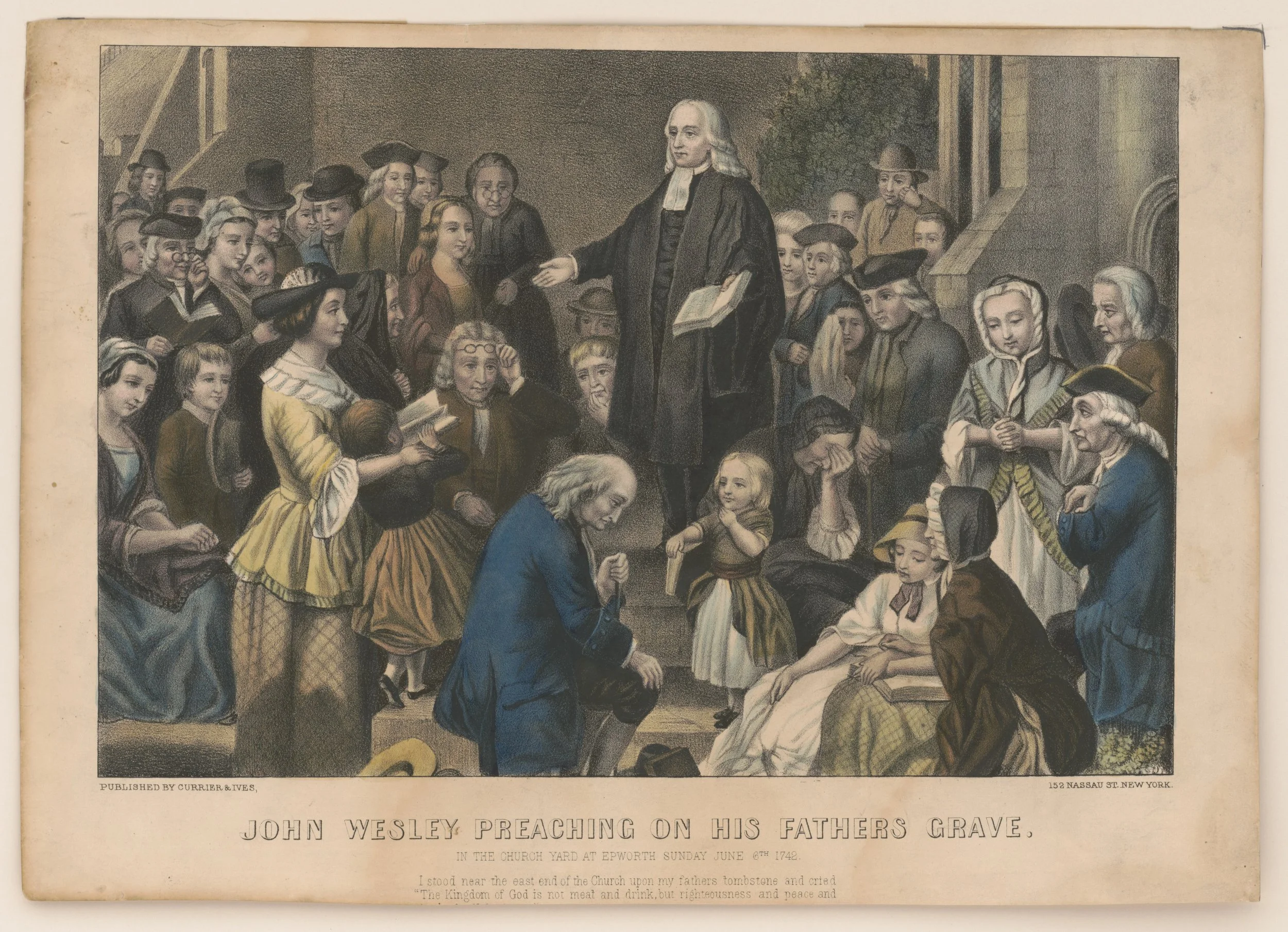
John and Charles Wesley were some of the most influential men of the 18th century church. Their preaching, teaching, and hymn-writing played a vital role in the first Great Awakening, has impacted generations of believers, and even sparked the start of several denominations beyond the Wesleyan-Methodist traditions. While John focused on traveling, preaching, and teaching, his brother, Charles, took to writing an unfathomable number of hymns. It is estimated that Charles Wesley wrote over 6,000 hymns in his lifetime, including: “Hark! The Herald Angels Sing”, “O for a Thousand Tongues to Sing”, and “And Can It Be That I Should Gain.”
As a Baptist, I have my disagreements with the Methodist tradition, but something to be appreciated about their worship is their observance of and dedication to a structured liturgy. You can see an example of this if you open to one of the first pages of almost any Methodist hymnal. There, you will find John Wesley’s rules for singing. These rules are not all directly applicable to our modern, Baptist context, but I do believe there is something to be learned from them.
Learn these tunes before you learn any others, afterwards learn as many as you please.
The insistence on “these tunes” is a bit heavy-handed, but it is important for us to be familiar with the songs that your church sings. Wesley’s heavy-handedness is balanced by his openness to learn other tunes. There are many great, faithful songs of worship out there. One church can only focus on and sing so many, so to enrich your soul, why not learn more, new songs?Sing them exactly as they are printed here, without altering or mending them at all; and if you have learned to sing them otherwise, unlearn it as soon as you can.
At King’s Hill, we do alter and mend songs, so I am in violation of this rule. Sorry, John Wesley. There is something to be said about truly knowing, in detail, the songs of the church. Take to the camaraderie and confidence of knowing songs and knowing them together with the congregation.Sing all – see that you join the congregation as frequently as you can. Let not a slight degree of weakness or weariness hinder you. If it is a cross to you, take it up and you will find a blessing.
What a great picture of sacrificially loving the body of Christ! In Ephesians 5, we see that we are to encourage one another with psalms, hymns, and spiritual songs. Even when you are tired and suffering, in lifting up your voice with the congregation, you have an opportunity to worship God and to encourage your brothers and sisters in Christ and to be encouraged by those same brothers and sisters.Sing lustily – and with good courage. Beware of singing as if you were half-dead or half-asleep; but lift up your voice with strength. Be no more afraid of your voice now, nor more ashamed of its being heard, than when you sang the songs of Satan.
Personally, this is my favorite of Wesley’s rules. In order to inspire conviction and boldness, he writes with conviction and boldness. I am sure we all know those who stand awkwardly and only barely sing (at best) during times of corporate worship. Maybe that’s you. To those who fit this description, consider what your body language and participation communicates to God and to those around you. If you were to imagine an unbeliever showing up to church for the first time, how would they sing? Is it similar to how you sing?Sing modestly – do not bawl so as to be heard above or distinct from the rest of the congregation that you may not destroy the harmony, but strive to unite your voices together so as to make one melodious sound.
This rule encourages unity in the congregation both in the output of one, corporate voice and individually, as we should seek to not be a distraction to those around us during worship. If you ever participated in choir, this rule is likely familiar to you. As a member of a choir, you must strike a balance between singing loud enough to be heard, but not so loud that you are louder than the rest of the choir around you. My high school choir director put it this way: you should be able to hear yourself sing, but you should also be able to hear those immediately around you.Sing in time – whatever time is sung, be sure to keep with it. Do not run before and do not stay behind it; but attend closely to the leading voices and move therewith as exactly as you can and take care not to sing too slow. This drawling way naturally steals on all who are lazy; and it is high time to drive it out from among us and sing all our tunes just as quick as we did at first.
As with the last rule, this is a practical consideration that aids in the unity of congregational singing. To Wesley’s point, I don’t think he is opposed to songs that are slower, but he is opposed to not singing songs slower than intended. Don’t shy away from noticing and feeling the rhythm of the music on a Sunday morning.Sing spiritually – have an eye to God in every word you sing. Aim at pleasing Him more than yourself, or any other creature. In order to attend strictly to the sense of what you sing, and see that your heart is not carried away with the sound, but offered to God continually; so shall your singing be such as the Lord will approve here, and reward when he cometh in the clouds of heaven.
The worship team and I always pray before stepping on stage. Often, I will pray that we, as musicians, would not be distracted by the technical details of playing and singing music, but that we would see and attend to these details as an act of worship. As another worship leader and friend of mine puts it, “May we use our gifts to worship God and not use God to worship our gifts.” There are great expressions of worship to be had in our music, but the gift of music should never supersede the giver of that gift, our Heavenly Father.
Although not directly fitting for our context and time, I hope Wesley’s rules for singing are an encouragement and even a source of conviction for you. The next time you have the opportunity to sing with your brothers and sisters, may you sing confidently, boldly, loudly, joyously, in unity, and most importantly, worshipfully.
